Alexander Polikarpov runs Tri Kita, a Tomsk company better known by its brand Retroznak — last autumn I built their address-plate landing page. The next project was a stove of his own design: Alexander drew it up himself, welded the first unit himself, and posted every stage of the work to a VKontakte group. In July 2026 the Russian patent office granted him utility model No. 244547. Selling came next, and selling needed a site.
The stove is steel, sized for a garage, a workshop, or a summer house. One thing sets it apart from its shelf neighbors, and that one thing matters: a vertical baffle splits the firebox in two. Logs go in U-shaped and burn in turn: the first half catches, the second joins in about an hour later. A single load gives 3–4 hours of open flame and another 5–6 hours of smoldering, with the air damper never closed. The engineering idea is not obvious at a glance. The whole site exists to explain it to someone who is simply picking something to heat a garage with.
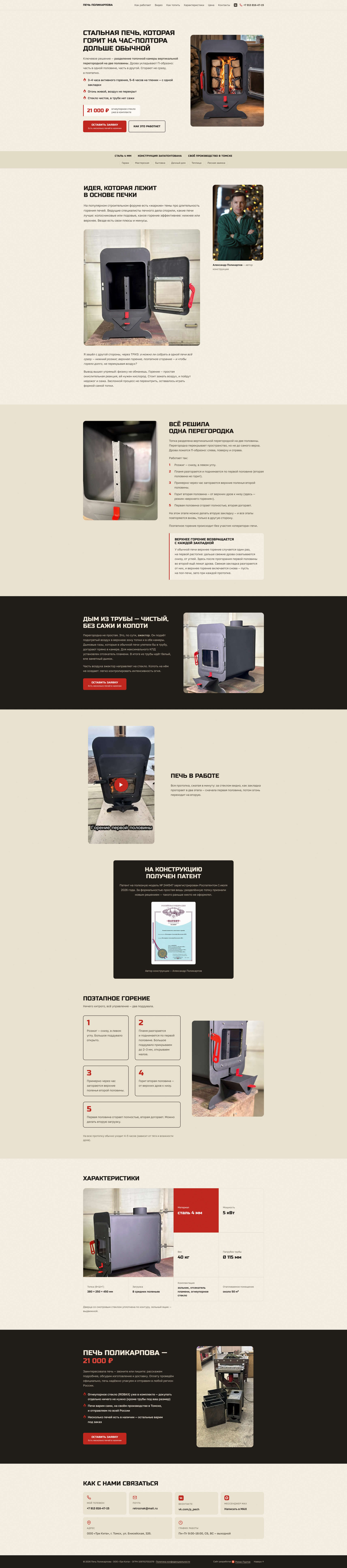
Ten screens walk the reader along one route: insight → solution → effects → proof → offer. First the invention story: stove builders on a construction forum argued over which design burns longer, and Alexander came at the problem from another angle, through TRIZ. Then a breakdown of the five burn stages and a dark block about afterburning the flue gases. Then the evidence: a vertical clip of a full burn, a scan of the patent, a five-step firing guide, a blueprint-style spec table. The offer and the contacts come last.
The palette is lifted off the stove itself: sand for the background, graphite for the body, the signal red of its handles. Headings are set in Russo One, body text in Golos Text, both fonts self-hosted. A film grain lies across the page, drawn by an SVG turbulence filter rather than an image. The spec table is built on grid-template-areas and reads like a technical drawing: a photo takes up a quarter of the grid, and the “4 mm steel” cell is picked out in red. The author’s portrait and the shot of the baffle ride along in sticky columns while you read.
Under the hood it is plain HTML, CSS, and JavaScript: no frameworks, no build step. A couple of dozen CSS variables hold the entire look in one file, so recoloring the site means editing five lines. The lead form lives in a native dialog and highlights bad fields with :user-invalid. On the production host a PHP handler takes submissions: it validates on the server, throttles repeat sends from one address, and slips UTM tags into the email so Alexander can see where the visitor came from.
Speed came from boring things: preloading two fonts, fetchpriority on the hero photo, explicit dimensions on everything else so nothing jumps while the page loads. The video weighs almost seven megabytes, so it only downloads after you press play. There are no third-party scripts on the page at all: no counters, no pixels. For search engines there is Product markup with price and availability, plus VideoObject for the clip. The Russian personal-data law is covered by a policy page and a mandatory consent checkbox. I published a public copy of the landing page in an open repository, with the form switched to demo mode.
Technologies: HTML5, CSS (дизайн-токены), Vanilla JS, GLightbox, PHP, JSON-LD, GitHub Pages
roman-purtow.ru/pech-polikarpova-public